
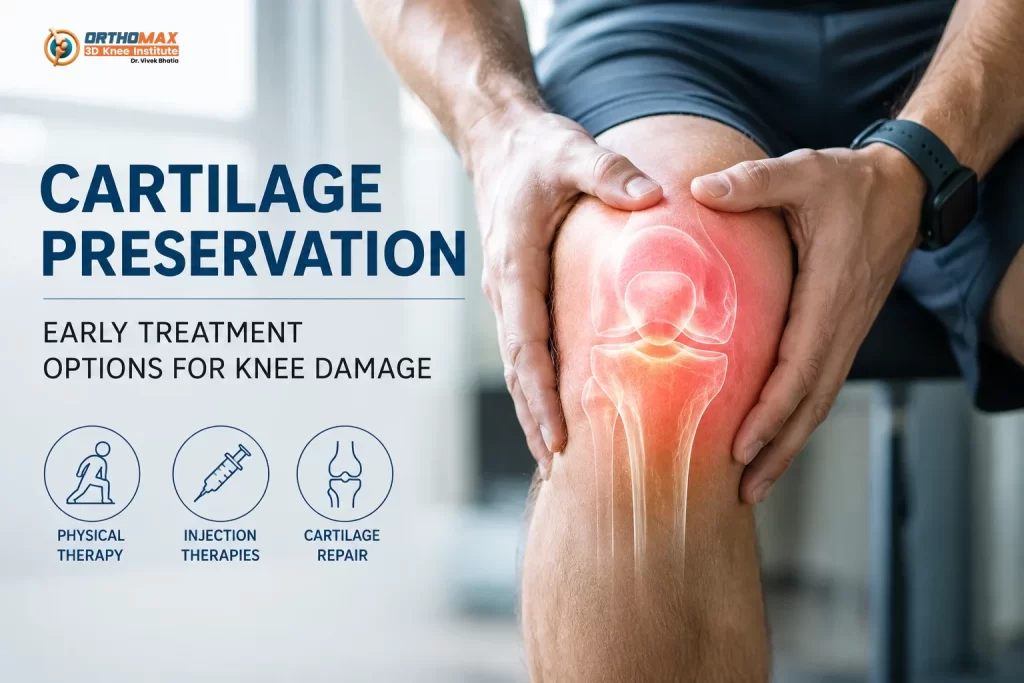
Cartilage Preservation: Early Treatment Options for Knee Damage
Knee pain does not always mean that knee replacement is the next step. In many cases, identifying cartilage damage early and choosing the right cartilage preservation strategy may help control symptoms, maintain knee function, and protect the joint for longer. Knee cartilage preservation can include lifestyle changes, physiotherapy, medicines, injections, and selected cartilage repair or restoration procedures. The right approach depends on the location, size and severity of the cartilage damage, along with the patient’s age, activity level and overall knee health.
This is important because articular cartilage has a limited ability to heal naturally. Unlike many other tissues, cartilage has no direct blood supply, which makes spontaneous healing difficult. Research also shows that no current cartilage restoration technique can perfectly reproduce normal hyaline cartilage.
What Is Knee Cartilage and Why Does It Matter?
Articular cartilage is a smooth, resilient layer of tissue that covers the ends of the bones inside the knee joint. It provides a low-friction surface, allowing the femur, tibia and kneecap to move smoothly during everyday activities such as walking, climbing stairs and bending the knee. It also helps distribute pressure across the joint and absorb some of the forces placed on the knee.
Healthy cartilage is essential for comfortable and efficient movement. When it becomes damaged, the surface may soften, crack, thin or develop a deeper defect. Depending on the extent and location of the injury, this can lead to pain, swelling, stiffness, reduced mobility or a grinding or catching sensation.
What Causes Knee Cartilage Damage?
Cartilage damage can develop gradually or occur following an injury. Common causes include:
- Sports injuries or direct trauma: A sudden impact, twisting injury or fall can damage the cartilage surface.
- Meniscus or ligament injuries: Problems involving the meniscus or ACL can alter how forces are distributed through the knee, potentially increasing stress on the cartilage.
- Repetitive joint loading: High-impact activities or repeated movements may contribute to cartilage damage, particularly when combined with other risk factors.
- Poor knee alignment: Bow-legged or knock-kneed alignment can place greater stress on specific areas of the joint.
- Previous knee surgery: Certain previous injuries or procedures may affect the long-term condition of the joint.
- Osteoarthritis: Progressive degeneration can cause cartilage to deteriorate over time.
- Osteochondral injuries: Some injuries affect not only the cartilage but also the underlying bone.
Focal Cartilage Damage vs. Advanced Osteoarthritis
Not all cartilage damage means that the knee has advanced arthritis. A person may have a focal cartilage defect, meaning damage is limited to a specific area while much of the surrounding cartilage remains relatively healthy.
This distinction matters when considering treatment. Patients with a well-defined cartilage defect and otherwise healthy knee structures may sometimes be candidates for knee cartilage repair or cartilage restoration procedures. In contrast, widespread cartilage loss associated with advanced osteoarthritis may require a different treatment approach.
An accurate diagnosis is therefore important before deciding on treatment. The location, size and depth of the cartilage defect, along with knee alignment, ligament stability, meniscus health, activity level and the presence of arthritis, all influence which cartilage preservation treatment may be appropriate.
Early Signs of Cartilage Damage in the Knee
Cartilage damage does not always produce obvious symptoms initially. Some people discover a cartilage defect during imaging performed for another knee problem.
When symptoms occur, they may include:
- Knee pain during walking, running or stairs
- Swelling after physical activity
- Stiffness
- Catching or locking sensations
- Reduced range of motion
- Pain after prolonged sitting
- Difficulty with squatting or kneeling
- Grinding or clicking sensations
Persistent symptoms after an injury should not simply be treated as normal aging. An orthopaedic assessment can help determine whether the problem involves cartilage, meniscus, ligaments, bone or another structure.
How Is Cartilage Damage Diagnosed?
Diagnosis usually begins with a medical history and physical examination. The doctor may assess knee stability, alignment, range of motion and areas of tenderness.
X-rays are useful for assessing bone alignment and joint-space changes associated with osteoarthritis. MRI can provide more detailed information about cartilage, menisci, ligaments and other soft tissues.
The important point is that treatment should not be based on an MRI report alone. The size and appearance of a cartilage defect need to be considered alongside symptoms, physical findings and the overall condition of the knee.
Cartilage Preservation Treatment: Start With the Basics
Not every cartilage injury requires surgery. In early disease, the objective of cartilage preservation treatment is often to reduce excessive joint stress, improve muscle support and control symptoms.
1. Physiotherapy and Therapeutic Exercise
Exercise is one of the most important conservative options for people with knee osteoarthritis and many other knee conditions.
A structured programme may include:
- Quadriceps strengthening
- Hamstring strengthening
- Hip and gluteal strengthening
- Low-impact aerobic activity
- Balance and neuromuscular training
- Flexibility exercises
The American Academy of Orthopaedic Surgeons recommends strengthening, low-impact aerobic exercise, neuromuscular education and physical activity for people with symptomatic knee osteoarthritis.
NICE similarly recommends tailored therapeutic exercise, including muscle strengthening and general aerobic fitness.
The goal is not to “regrow” cartilage through exercise. Instead, stronger muscles can improve joint support and physical function while helping patients remain active.
2. Weight Management
For people with excess body weight, weight management can be an important part of how to preserve knee cartilage and manage osteoarthritis symptoms.
The AAOS recommends sustained weight loss to improve pain and function in overweight and obese patients with knee osteoarthritis.
NICE also recommends weight management where appropriate and notes that losing 10% of body weight is likely to provide greater benefits than losing 5%.
Weight management should not be viewed as a quick fix. It works best when combined with appropriate physical activity, nutrition and professional guidance.
3. Activity Modification
Complete rest is rarely the long-term answer. Instead, patients may need to modify activities that repeatedly overload the knee.
For example, a person with painful cartilage damage may temporarily reduce:
- High-impact running
- Repeated jumping
- Deep squats
- Activities involving frequent twisting
- High-load exercises that aggravate symptoms
Low-impact activities such as cycling, swimming or controlled walking may be better tolerated, depending on the individual’s condition.
Medicines and Injections for Knee Cartilage Symptoms
Medication does not rebuild damaged cartilage. However, it can sometimes help control pain and inflammation so that patients can participate in rehabilitation.
Topical or oral NSAIDs may be considered where appropriate, taking individual risks and contraindications into account. NICE recommends topical NSAIDs for knee osteoarthritis and advises that medicines should generally be used alongside non-pharmacological treatment.
Corticosteroid injections may provide short-term symptom relief in selected patients. NICE states that their benefit is generally short term, around 2 to 10 weeks.
It is important to distinguish symptom management from cartilage restoration. An injection that reduces pain does not necessarily mean that damaged cartilage has been repaired.
Knee Cartilage Repair: When Is Surgery Considered?
When a patient has a symptomatic focal cartilage defect that does not improve adequately with conservative treatment, a specialist may consider knee cartilage repair or restoration.
The choice depends on several factors, including:
- Patient age
- Defect size
- Defect depth
- Location of the lesion
- Whether underlying bone is involved
- Knee alignment
- Meniscus condition
- Ligament stability
- Activity requirements
- Presence or absence of widespread osteoarthritis
International Cartilage Repair Society guidance highlights defect size, depth, location and the condition of surrounding structures as important considerations when evaluating cartilage repair.
1. Microfracture
Microfracture is a marrow-stimulation technique. Small openings are created in the underlying bone so that marrow elements can enter the cartilage defect and form repair tissue.
It is generally considered for selected smaller defects. However, the resulting tissue is often fibrocartilage rather than normal hyaline cartilage, and long-term durability can be an important consideration.
2. Osteochondral Autograft Transfer
Osteochondral autograft transfer, sometimes called OATS or mosaicplasty, transfers small plugs of healthy cartilage and underlying bone from another area of the patient’s knee into the damaged region.
It can be considered for selected focal defects, particularly when a durable cartilage surface is required. The amount and location of available donor tissue can limit its use.
3. Autologous Chondrocyte Implantation
Autologous chondrocyte implantation (ACI) uses cartilage cells obtained from the patient. The cells are expanded and later implanted into the cartilage defect.
ACI and related matrix-assisted approaches may be considered for selected larger focal defects. Research suggests that patient outcomes can improve following ACI, although the evidence does not establish one cartilage restoration procedure as universally superior.
4. Osteochondral Allograft
An osteochondral allograft uses donor cartilage and bone to treat selected larger or complex defects. It may be considered when a defect is too large for an autograft or when substantial bone involvement exists.
This is a specialised procedure and is not appropriate for every patient.
Can Cartilage Preservation Delay Knee Replacement?
One of the most common questions is: can cartilage preservation delay knee replacement?
The answer is: sometimes, but it cannot be guaranteed.
Early management may help control symptoms, maintain mobility and address factors that contribute to joint deterioration. For carefully selected patients with focal cartilage defects, cartilage restoration procedures may provide an alternative to arthroplasty.
However, cartilage preservation is not a promise that knee replacement will never be needed. Advanced osteoarthritis, substantial joint-space loss, deformity, persistent pain and major functional limitations may eventually require joint replacement.
NICE recommends considering referral for joint replacement when symptoms substantially affect quality of life and non-surgical management is ineffective or unsuitable.
Therefore, the realistic objective is joint preservation where appropriate, rather than avoiding knee replacement at any cost.
What Does the Research Say About Cartilage Repair?
A 2024 systematic review and network meta-analysis evaluated 19 randomised controlled trials involving different procedures for knee cartilage defects, including microfracture, AMIC, osteochondral transplantation and ACI. The pooled analysis did not identify a clear difference in patient-reported outcomes between the techniques across short-, intermediate- and long-term follow-up periods.
Another systematic review comparing ACI and microfracture found that both approaches could improve clinical outcomes at five years, with some modified ACI techniques showing better results for selected outcomes.
This tells us something important: there is no single cartilage repair procedure that is right for everyone. Patient selection may be just as important as the procedure itself.
Who May Benefit From Early Cartilage Preservation?
Early assessment may be particularly useful for people who:
- Have persistent knee pain following an injury
- Have a known focal cartilage defect
- Are physically active and want to maintain activity
- Have symptoms despite appropriate physiotherapy
- Have early degenerative changes rather than end-stage arthritis
- Have mechanical symptoms such as catching or locking
- Have cartilage damage with otherwise good knee stability and alignment
People who travel frequently, work physically demanding jobs or are planning a relocation may also benefit from addressing persistent knee symptoms early rather than postponing evaluation until pain significantly affects mobility.
When Should You See an Orthopaedic Specialist?
Consider an assessment if knee pain continues for several weeks, repeatedly returns after activity, or interferes with walking, stairs, exercise or sleep.
Seek prompt medical evaluation after significant trauma, particularly when there is:
- Rapid swelling
- Inability to bear weight
- Significant instability
- A locked knee
- Severe pain
- Loss of normal movement
Early evaluation does not automatically mean surgery. In many cases, the first step is understanding the cause of pain and creating an appropriate non-surgical treatment plan.
Frequently Asked Questions
1. What is cartilage preservation?
Cartilage preservation refers to strategies used to protect remaining knee cartilage, reduce joint stress, improve function and manage symptoms. Depending on the condition, it may include exercise, physiotherapy, weight management, medication, injections or cartilage restoration surgery.
2. Can damaged knee cartilage heal naturally?
Articular cartilage has limited natural healing capacity because it lacks a direct blood supply. Small injuries may sometimes remain stable or cause minimal symptoms, but significant defects generally do not predictably regenerate normal cartilage on their own.
3. What is the best knee cartilage treatment?
There is no single best treatment for every cartilage injury. Treatment depends on the defect’s size, location and depth, as well as age, activity level, alignment, meniscus health and the presence of osteoarthritis.
4. Is cartilage repair the same as cartilage replacement?
No. Cartilage repair generally attempts to stimulate or support the body’s repair response. Cartilage restoration may involve transplanting cartilage or using a cell-based technique to restore the damaged surface.
5. Can exercise preserve knee cartilage?
Exercise cannot reliably regrow damaged cartilage, but appropriate strengthening and aerobic activity can improve muscle support, physical function and symptoms. Therapeutic exercise is a core treatment for knee osteoarthritis.
6. Can cartilage preservation delay knee replacement?
It may delay the need for replacement in some patients, particularly when damage is identified early and the underlying problem can be effectively managed. However, it cannot guarantee that knee replacement will never be necessary.
7. Is microfracture suitable for everyone?
No. Microfracture is generally used for selected focal cartilage defects. Lesion size, location, patient factors and the overall condition of the knee influence whether it is appropriate.
8. Is MRI necessary for knee cartilage damage?
MRI can provide detailed information about cartilage and other soft tissues, but the need for MRI depends on the clinical situation. A doctor should interpret imaging alongside symptoms and physical examination findings.
9. Does weight loss help with knee cartilage problems?
For people with overweight or obesity and knee osteoarthritis, weight loss can improve pain and physical function. NICE considers weight management a core component of osteoarthritis care.
10. When should I see a doctor for knee cartilage symptoms?
See an orthopaedic specialist if persistent knee pain, swelling, stiffness, locking or reduced mobility is affecting daily activities or does not improve with appropriate self-care. Early assessment can help identify whether the problem is cartilage-related and whether preservation or repair options are appropriate.
Key Takeaway
Cartilage preservation is not one treatment. It is a broader approach to protecting knee function and managing cartilage damage at an appropriate stage.
For early disease, physiotherapy, strengthening, low-impact exercise, activity modification and weight management can form the foundation of treatment. Selected patients with focal defects may be considered for cartilage repair or cartilage restoration procedures such as microfracture, osteochondral autograft transfer or ACI.
The most important factor is appropriate patient selection. Cartilage repair is different from treating advanced osteoarthritis, and no procedure can guarantee permanent preservation of the natural knee.
If knee pain is persistent, getting an accurate diagnosis early can help you understand the available options before the condition becomes more difficult to manage.