
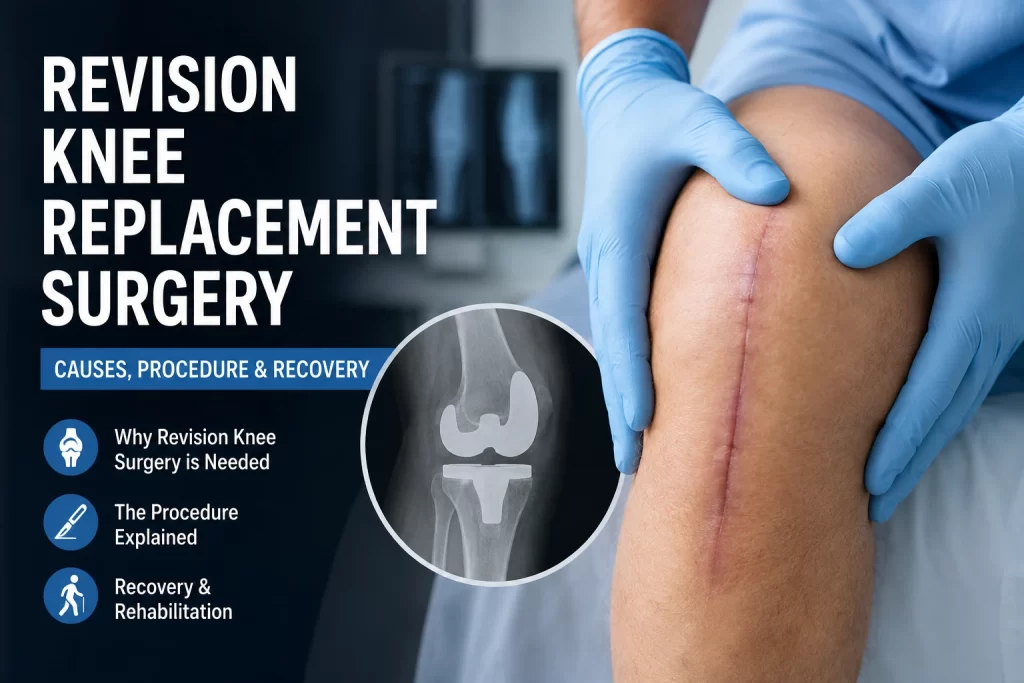
Revision Knee Replacement Surgery: Causes, Procedure & Recovery
Revision knee replacement surgery is a specialised procedure performed when a previous knee replacement no longer functions as expected. While modern knee replacement implants are designed to last for many years, they may eventually wear out, loosen, become infected, or fail due to other complications. In such cases, revision knee replacement surgery helps restore joint function, reduce pain, and improve mobility.
Unlike a primary knee replacement, revision surgery is more complex because the surgeon must remove the existing implant, evaluate the surrounding bone and soft tissues, and replace it with a new prosthesis. Advances in implant technology, surgical planning, and robotic-assisted techniques have significantly improved the outcomes of revision procedures.
This guide explains why revision knee replacement surgery may be required, the warning signs to watch for, how the procedure is performed, expected recovery, potential risks, and frequently asked questions.
What Is Revision Knee Replacement Surgery?
Revision knee replacement surgery is a procedure performed to replace or repair a previous knee replacement when the original implant has failed or is no longer functioning as intended. It may be recommended if the artificial joint becomes loose, wears out over time, becomes infected, or if complications such as instability, stiffness, or a fracture around the implant affect knee function.
Depending on the underlying problem, revision surgery may involve replacing:
- A single component of the implant
- Multiple implant components
- The entire knee prosthesis
Compared with a primary knee replacement, revision surgery is generally more complex. The surgeon may need to remove the existing implant, address bone loss or damaged soft tissues, and reconstruct the joint using specialised revision implants. Because each case is different, the surgical approach is tailored to the patient’s condition, the reason for implant failure, and the quality of the surrounding bone and ligaments.
Why Might a Knee Replacement Need Revision?
Although knee replacement surgery has excellent long-term outcomes, no artificial joint is designed to last indefinitely. According to the American Academy of Orthopaedic Surgeons (AAOS) and data from national joint replacement registries, many modern knee replacements continue to function well for 15 to 20 years or longer, particularly when the implant is well-positioned and the patient maintains good overall joint health. However, some patients may require revision knee replacement surgery earlier due to implant-related problems, injury, infection, or other complications.
Common reasons for revision include:
1. Implant Wear
The plastic (polyethylene) spacer between the metal components can gradually wear down over time, particularly after many years of use. Although advances in implant materials have improved durability, wear can still occur and may produce microscopic particles that trigger inflammation. In some cases, this inflammatory response contributes to bone loss around the implant (osteolysis), increasing the risk of implant loosening.
2. Implant Loosening (Aseptic Loosening)
Aseptic loosening refers to the loss of fixation between the implant and the surrounding bone without the presence of infection. It remains one of the most common reasons for revision knee replacement. Patients may experience increasing pain during weight-bearing activities, reduced stability, or difficulty performing everyday movements.
3. Periprosthetic Joint Infection
A deep infection around the artificial knee joint can develop shortly after surgery or many years later through the spread of bacteria from another part of the body. Because bacteria can adhere to the implant surface and form protective biofilms, antibiotics alone are often insufficient to eradicate the infection. Depending on the severity, treatment may involve one-stage or two-stage revision surgery in addition to targeted antibiotic therapy.
4. Knee Instability
If the supporting ligaments become damaged or the implant no longer provides adequate stability, the knee may feel as though it is giving way during walking or changing direction. Instability can affect balance, reduce confidence while walking, and increase the risk of falls, making revision surgery necessary in selected cases.
5. Periprosthetic Fracture
A fracture involving the bone surrounding the knee implant may occur after a fall, trauma, or in individuals with weakened bone quality, such as osteoporosis. Depending on the location and severity of the fracture, revision surgery may be required to restore stability and joint function.
6. Persistent Stiffness
Some patients develop significant stiffness after knee replacement despite appropriate rehabilitation. If reduced range of motion is caused by implant malposition, excessive scar tissue, or mechanical problems that cannot be managed with non-surgical treatment, revision surgery may be considered after careful assessment.
7. Persistent Pain
Persistent pain following knee replacement does not always indicate implant failure. It may be related to soft tissue conditions, nerve-related pain, infection, implant loosening, instability, or problems involving the hip or spine. A detailed clinical evaluation, supported by imaging and, where appropriate, laboratory investigations, is essential to identify the underlying cause. Revision surgery is considered only when a treatable implant-related problem has been confirmed.
Signs You May Need Revision Knee Replacement Surgery
Not everyone who experiences pain or discomfort after a knee replacement will require revision knee replacement surgery. However, persistent or new symptoms should be evaluated by an orthopaedic surgeon, particularly if they interfere with daily activities or worsen over time.
Signs that may indicate a problem with the existing knee implant include:
- Persistent or worsening knee pain
- Swelling that does not improve or keeps returning
- Knee instability or a feeling that the joint is giving way
- Reduced range of motion or increasing stiffness
- Difficulty walking or climbing stairs
- New pain during weight-bearing activities
- Warmth, redness, or drainage around the surgical site
- Fever accompanied by knee pain or swelling, which may suggest infection
- Clicking, grinding, or other unusual mechanical sensations associated with pain or instability
- A noticeable change in the alignment or function of the knee
These symptoms do not always mean that revision surgery is necessary. They may be caused by implant wear, loosening, infection, instability, or other conditions that require medical assessment. An orthopaedic surgeon will typically perform a physical examination and may recommend imaging tests, blood tests, or joint fluid analysis to determine the underlying cause and the most appropriate treatment.
Seeking medical advice early can help identify potential complications before they progress and may improve treatment outcomes.
How Is Revision Knee Replacement Diagnosed?
Before recommending revision knee replacement surgery, your orthopaedic surgeon will perform a thorough evaluation to determine why the original knee replacement is no longer functioning properly. The assessment combines your medical history, physical examination, imaging studies, and laboratory tests to identify the underlying cause, such as implant loosening, infection, instability, or wear.
1. Medical History
Your surgeon will review your previous knee replacement surgery, current symptoms, pain pattern, medical conditions, activity level, and any history of infection or injury. Understanding when the symptoms began and how they have progressed helps narrow down the possible cause of implant failure.
2. Physical Examination
A detailed physical examination assesses the knee for swelling, tenderness, range of motion, alignment, stability, muscle strength, and gait. Your surgeon will also evaluate how the knee functions during movement and look for signs of instability or infection.
3. X-rays
Weight-bearing X-rays are usually the first imaging test performed. They help assess the position of the implant and can identify loosening, component wear, changes in alignment, fractures around the implant, or areas of bone loss.
4. CT Scan
A CT scan may be recommended when additional detail is needed. It provides a more detailed assessment of bone quality, bone loss, implant positioning, and fixation, particularly in complex revision cases.
5. MRI
Although conventional MRI is limited by metal implants, specialised metal artifact reduction MRI (MARS MRI) techniques can help evaluate the surrounding soft tissues, including muscles, tendons, ligaments, and fluid collections when clinically indicated.
6. Blood Tests
Blood tests, including erythrocyte sedimentation rate (ESR) and C-reactive protein (CRP), are commonly used to look for signs of inflammation that may indicate a prosthetic joint infection. However, these tests are not diagnostic on their own and must be interpreted alongside other clinical findings.
7. Joint Aspiration
If infection is suspected, your surgeon may perform a joint aspiration (arthrocentesis) to collect fluid from the knee. The sample is analysed for white blood cell count, bacterial culture, and other markers that help diagnose or rule out a prosthetic joint infection. The results are considered together with imaging, blood tests, and your clinical assessment before deciding on the most appropriate treatment.
Revision Knee Replacement Procedure
Revision knee replacement surgery is typically performed under general anaesthesia or spinal anaesthesia, depending on the patient’s overall health, medical history, and the anaesthetist’s recommendation. The surgical approach varies based on the reason for revision, such as implant loosening, infection, instability, implant wear, or bone loss.
Step 1: Removing the Existing Implant
The surgeon carefully removes the original knee implant while preserving as much healthy bone as possible. Any remaining bone is thoroughly assessed to determine whether reconstruction is required before the new implant is inserted.
Step 2: Assessing and Preparing the Joint
After the implant is removed, the joint is carefully examined. Scar tissue, damaged tissue, or any loose debris is removed, and the surrounding bone is prepared for the revision implant. If infection is suspected or confirmed, tissue samples may be collected for laboratory testing. In cases of chronic infection, a two-stage revision is often recommended. During the first stage, the infected implant is removed, the joint is thoroughly cleaned (debridement), and an antibiotic-loaded spacer is placed. Once the infection has been successfully treated, a second procedure is performed to implant the new knee prosthesis.
Step 3: Reconstructing Bone Defects
Revision surgery may reveal areas of bone loss caused by implant loosening, wear, or previous surgery. Depending on the extent of the defect, the surgeon may use bone grafts, metal augments, sleeves, cones, or longer stemmed implants to restore stability and provide secure support for the new prosthesis.
Step 4: Implanting the Revision Prosthesis
A specialised revision knee implant is then positioned and secured. Compared with standard knee replacement implants, revision components are often designed to provide additional stability and fixation when bone or ligament support has been compromised.
Step 5: Closing the Incision and Beginning Recovery
Once the new implant is in place and its stability and alignment have been confirmed, the incision is closed using sutures or staples, and a sterile dressing is applied. Patients are usually encouraged to begin gentle movement and physiotherapy within the first day after surgery, depending on their overall condition and the surgeon’s post-operative protocol.
Types of Revision Knee Replacement
The type of revision knee replacement surgery depends on several factors, including the reason the original implant has failed, the condition of the surrounding bone and soft tissues, the stability of the knee, and whether an infection is present. After a thorough clinical assessment and imaging, your orthopaedic surgeon will recommend the most appropriate approach.
1. Partial Revision
A partial revision involves replacing only the damaged or worn component of the knee implant while retaining the well-fixed and properly functioning components. This option may be suitable when the remaining parts of the prosthesis are stable, well-aligned, and free from infection. Because less bone and soft tissue are disturbed, recovery may be less extensive than with a complete revision, although suitability depends on individual circumstances.
2. Complete Revision
A complete revision knee replacement involves removing all components of the existing implant and replacing them with a new prosthesis. This procedure is typically recommended when multiple components have loosened, the implant has worn significantly, alignment problems are present, or there is substantial bone loss or joint instability. Revision implants are often designed with longer stems, augments, or specialised components to provide additional stability and support.
3. Revision for an Infected Knee Replacement
When a deep periprosthetic joint infection is diagnosed, revision surgery is often required to remove the infected implant and eliminate the infection before a new knee replacement can be safely inserted. In many cases, particularly for chronic infections, a two-stage revision is considered the standard treatment. During the first stage, the infected implant is removed, the joint is thoroughly cleaned, and an antibiotic-loaded spacer is placed. After the infection has been successfully treated and clinical and laboratory findings indicate it has resolved, a second procedure is performed to implant a new knee prosthesis.
In selected patients with specific types of infection and favourable clinical factors, a one-stage revision, in which the infected implant is removed and replaced during the same operation, may also be considered. The most appropriate approach is determined by the treating orthopaedic surgeon based on the patient’s overall condition and the nature of the infection.
Recovery After Revision Knee Replacement Surgery
Recovery after revision knee replacement surgery is generally longer and more variable than recovery following a primary knee replacement. This is because revision procedures are often more complex and may involve removing the existing implant, addressing bone loss, treating infection, or reconstructing damaged soft tissues.
Most patients begin rehabilitation shortly after surgery, with a personalised recovery plan based on the reason for the revision, the type of procedure performed, and their overall health.
Recovery Stage | What to Expect |
First few days | Patients are encouraged to begin gentle movement and walking with the support of a physiotherapist or walking aid, depending on their condition. |
2-6 weeks | Pain and swelling gradually improve. Physiotherapy focuses on restoring knee movement, improving strength, and increasing mobility. |
6-12 weeks | Many patients regain greater independence in daily activities, although some may still require walking aids or ongoing rehabilitation. |
3-6 months | Continued improvements in strength, flexibility, balance, and overall knee function are common with consistent rehabilitation. |
Up to 12 months or longer | Recovery may continue for a year or more, particularly after complex revision procedures involving significant bone reconstruction or treatment of infection. |
Recovery timelines vary between individuals and depend on several factors, including the patient’s age, general health, bone quality, muscle strength, the reason for revision surgery, and adherence to the prescribed rehabilitation programme. Regular follow-up appointments allow the orthopaedic surgeon to monitor healing, assess implant stability, and address any concerns during recovery.
Rehabilitation and Physiotherapy
Rehabilitation is an essential part of recovery after revision knee replacement surgery. A structured physiotherapy programme helps improve knee movement, restore muscle strength, reduce stiffness, and support a safe return to everyday activities. The rehabilitation plan is tailored to each patient based on the complexity of the revision procedure, overall health, and individual recovery goals.
A physiotherapy programme may include:
- Gentle range-of-motion exercises to improve knee bending and straightening
- Strengthening exercises for the quadriceps, hamstrings, and surrounding muscles
- Walking practice using assistive devices such as a walker or crutches, if required
- Balance and coordination exercises to improve stability
- Stair-climbing and functional movement training
- Gradual progression to everyday activities under professional guidance
Patients should follow the rehabilitation programme recommended by their orthopaedic surgeon and physiotherapist. Returning to high-impact activities too early may increase stress on the revised knee joint. Regular exercise, combined with scheduled follow-up appointments, helps monitor progress and supports the best possible functional outcome.
How Long Does a Revision Knee Replacement Last?
The lifespan of a revision knee replacement varies depending on the reason for the revision, the patient’s overall health, bone quality, activity level, and the type of implant used. While many revision knee replacements provide durable pain relief and improved function for many years, they generally do not last as long as primary knee replacements.
Studies from national joint registries and peer-reviewed orthopaedic literature suggest that many revision knee replacements continue to function well for 10 years or more, although individual outcomes vary. Regular follow-up with an orthopaedic surgeon is important to monitor the implant and detect any potential issues at an early stage.
Factors that can influence implant longevity include:
- The underlying reason for the revision (such as infection or implant loosening)
- Bone quality and the amount of bone loss
- Patient age and overall health
- Body weight and activity level
- Implant design and surgical technique
- Adherence to rehabilitation and follow-up care
Maintaining a healthy weight, staying physically active within your surgeon’s recommendations, and attending routine follow-up appointments can help maximise the lifespan of a revision knee replacement.
Frequently Asked Questions
1. What is revision knee replacement surgery?
Revision knee replacement surgery replaces or repairs a previous knee implant that has failed because of wear, loosening, infection, instability, fractures, or other complications.
2. How long does revision knee replacement surgery take?
The procedure typically takes between two and four hours, depending on the complexity of the revision.
3. Is revision knee replacement more difficult than primary knee replacement?
Yes. Revision surgery is generally more complex because the surgeon must remove the old implant, manage bone loss, and reconstruct the joint.
4. How painful is revision knee replacement recovery?
Pain is expected initially but is managed with medications, physiotherapy, and rehabilitation. Most patients gradually experience improved comfort as healing progresses.
5. How long does recovery take after revision knee replacement?
Many patients recover enough for daily activities within three to six months, while complete recovery may continue for up to one year.
6. What causes a knee replacement to fail?
Common causes include implant loosening, wear, infection, instability, fractures around the implant, and persistent pain.
7. Can an infected knee replacement be revised?
Yes. Many infected knee replacements are treated using a staged revision procedure after the infection has been controlled.
8. How successful is revision knee replacement surgery?
Most appropriately selected patients experience significant improvements in pain relief, mobility, and overall function following surgery.
9. Will I need physiotherapy after revision surgery?
Yes. Physiotherapy is an essential part of recovery and helps restore movement, strength, and joint function.
10. When should I contact my surgeon after surgery?
Contact your surgeon immediately if you experience increasing pain, fever, wound drainage, severe swelling, calf pain, or sudden inability to bear weight.
Conclusion
Revision knee replacement surgery is an effective solution for patients whose previous knee replacement has failed due to loosening, infection, wear, instability, fractures, or persistent pain. Although it is more complex than primary knee replacement, advances in surgical techniques, implant design, imaging technology, and rehabilitation have improved patient outcomes significantly.
If you are experiencing ongoing pain, instability, or reduced function after a knee replacement, consult an experienced orthopaedic surgeon for a thorough evaluation. Early diagnosis helps determine the underlying cause and allows timely treatment to restore comfort, mobility, and quality of life.
A personalised assessment is the best way to determine whether revision knee replacement surgery is the most appropriate treatment option for your condition.